The Ultimate Guide to AV over IP:
Encoders, Decoders & Capture Cards
The modern video landscape demands scalable, high-quality, low-latency distribution across multiple locations and platforms simultaneously. This guide breaks down exactly how NDI encoders, hardware decoders and multi-input PCIe capture cards power professional video networks across ten major industries — and how to choose the right hardware for your specific deployment.
01 What Is AV over IP — And Why Does It Matter? #what-is
AV over IP (Audio-Visual over Internet Protocol) is the transmission of audio and video data over standard local area networks or the wider internet — replacing dedicated point-to-point cable runs with intelligent, packet-based network infrastructure.
Traditional AV infrastructure is built around point-to-point signal routing — a camera connects to a specific monitor, a specific switcher port feeds a specific display. Every new source or destination requires a new cable run. In a large venue, university campus or multi-floor corporate headquarters, this becomes a rigid, expensive and difficult-to-modify infrastructure.
AV over IP replaces that rigid infrastructure with the same Ethernet network already running in your building. Any camera on the network can feed any display on the network. Any encoder can push to any number of simultaneous destinations. Routing changes happen in software, in seconds, without touching a single cable.
02 The Three Hardware Tiers #three-tiers
Every professional AV over IP deployment is built on three foundational hardware tiers. Understanding what each tier does — and where the boundaries between them lie — is the starting point for any system design.
Encoders
Takes a physical video source — HDMI, SDI, CVBS — and compresses it into a network-transmissible stream protocol such as NDI, SRT or RTMP. Can be a standalone box connected directly to a camera, or a PCIe card installed inside a production server. The encoder is the entry point of every IP video pipeline.
Decoders
Located at the destination, a decoder pulls a network stream and converts it back into a physical baseband signal — HDMI or SDI — to feed local displays, projectors, or hardware production switchers. Decoders make it possible to place a display anywhere on the network without running a physical cable from the source.
PCIe Capture Cards
When working directly with a production computer or server, PCIe capture cards bypass network overhead entirely. They ingest multiple high-bandwidth video sources directly into the machine's hardware bus with sub-frame latency — making them the standard choice for multi-camera production software, broadcast servers and medical imaging systems.
03 Ten Industries Driving Demand #industries
AV over IP is not a single-use technology. The same fundamental architecture — encoders, decoders, capture cards, IP network — solves radically different problems across every major sector. Understanding how each industry applies the technology reveals the correct hardware specification for each deployment type.
Corporate AV & Multi-National Companies
Enterprise environments face the challenge of distributing executive town halls, investor briefings and training content across multiple regional offices and online platforms simultaneously. A single event may need to reach a boardroom in London, a branch office in Manchester, a remote workforce on Microsoft Teams, and a public YouTube Live stream — all at the same time.
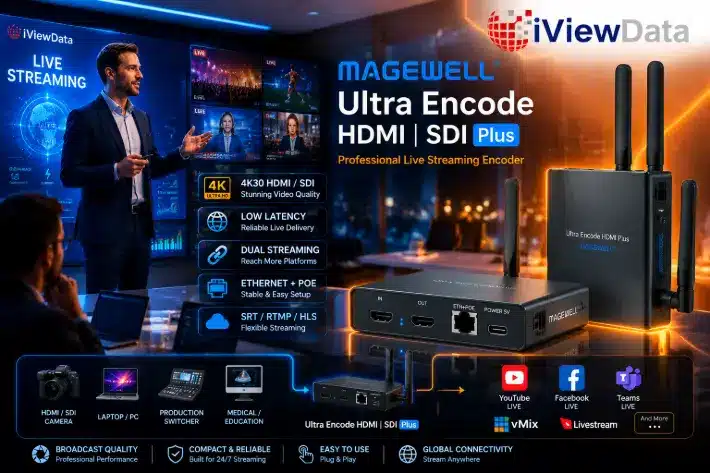
The correct architecture uses standalone hardware encoders at the source location feeding multiple simultaneous RTMP and SRT destinations. Decoders at each remote office location decode the stream back to HDMI for display in meeting rooms — without any PC at the destination. Corporate IT teams specify hardware that presents itself as a UVC-compliant webcam to Teams and Zoom, requiring no driver installation on locked-down corporate devices.
Professional AV System Integrators
For system integrators, the economics of physical cabling at scale are prohibitive. Running 12G-SDI across a 50,000 sq ft corporate campus or a multi-floor university building means cutting channels through walls, installing cable trays, and deploying physical matrix switchers that cost tens of thousands of pounds — and become obsolete when the building layout changes.
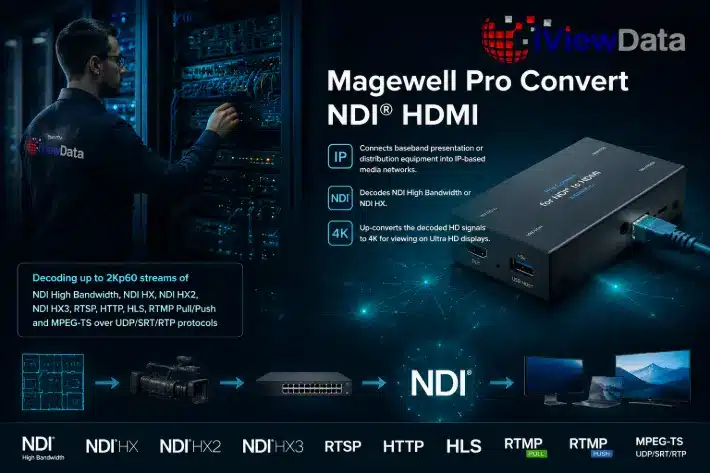
NDI over existing Ethernet transforms the installed network into a software-defined video matrix. Because NDI allows bidirectional discovery, any device added to the network can instantly access any camera source without a single new cable run. Routing changes happen in software in seconds. For integrators, this fundamentally changes the conversation with clients — from "how much will it cost to add another camera feed to that room?" to "it is already available, we just need to configure it."
Education — Lecture Capture & Distance Learning
Higher education institutions require multi-source capture from environments where the lecturer's PC is locked down, IT provisioning is slow, and technical staff are not available in every room. A typical lecture capture system ingests a presenter tracking camera, a document camera, and a digital whiteboard or slide presentation feed — simultaneously, from a single device.
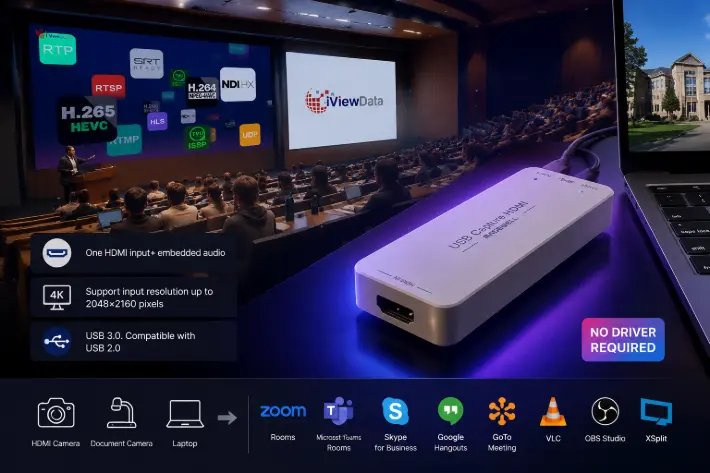
The critical requirement is UVC compliance. A UVC-compliant capture device presents itself to the operating system as a standard webcam — no driver installation, no IT approval required, no admin rights needed. The device works instantly on any Windows, macOS or Linux machine and appears in Panopto, Kaltura, Teams, and any other video application automatically.
Medical Environments — Surgical & Clinical Imaging
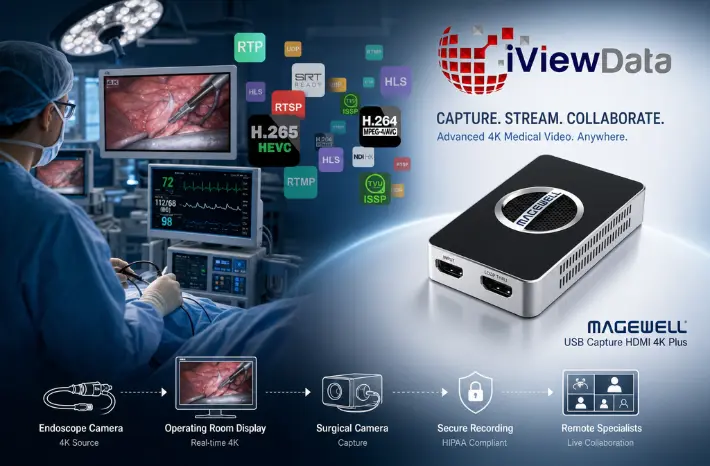
Medical capture has requirements that differ fundamentally from broadcast production. Galvanic isolation between the capture device and the patient circuit is a clinical requirement — leakage current through connected equipment can cause direct harm. Capture devices used in surgical theatres must meet IEC 60601 electrical safety standards or be isolated from patient-connected equipment by a compliant isolator.
Modern surgical theatres route 4K endoscopic camera outputs, patient vital monitor feeds and ambient room cameras simultaneously to observation auditoriums, student classrooms, and remote specialists via encrypted SRT streams. The capture hardware must be absolutely reliable — a dropped frame in a lecture theatre is annoying; a dropped frame during a surgical procedure review is unacceptable.
Government & Public Sector
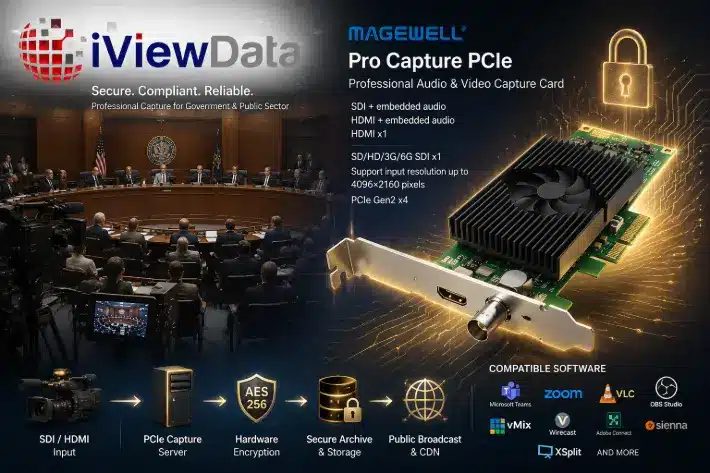
Government video infrastructure operates under security and compliance requirements that consumer and prosumer hardware cannot meet. Network segmentation is critical — the internal capture and recording network must be completely isolated from the public broadcast network. A breach of that boundary represents a security incident, not just a technical failure.
PCIe capture cards installed in secure, firewalled servers ensure that high-volume public archives are handled entirely on-premises without public internet exposure. Simultaneously, SRT with AES-256 encryption provides a secure, authenticated path for public broadcast streams — the encryption key ensures only authorised decoders can receive the stream.
Television & Broadcast Production
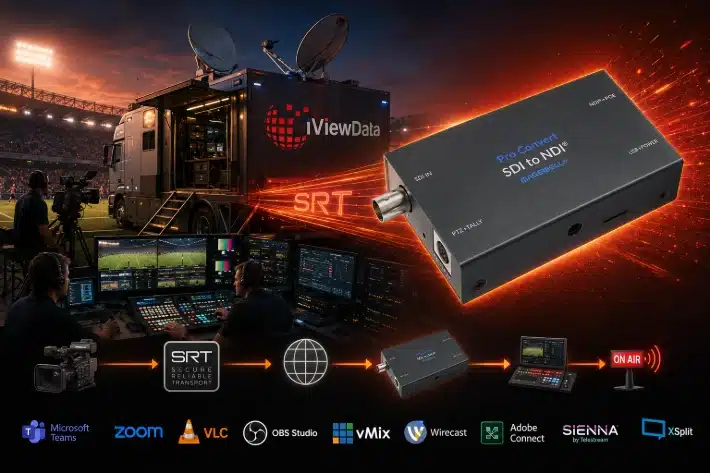
Legacy television networks are actively migrating from traditional SDI baseband routing to IP-centric production networks — driven by SMPTE ST 2110 and NMOS standards for professional broadcast IP. Remote production (REMI) is the most immediate commercial driver: sending a minimal crew to a live venue while all switching, mixing and graphics happen back at a centralised media headquarters reduces outside broadcast costs by 40–60%.
SRT is the contribution protocol of choice for REMI — its built-in ARQ packet recovery maintains broadcast-grade quality over public internet connections that would cause RTMP to corrupt or drop. Field encoders convert SDI camera outputs to SRT at the venue; broadcast-grade decoders reconstruct the signal at the studio with sub-second latency.
Sports Organisations & Live Venues
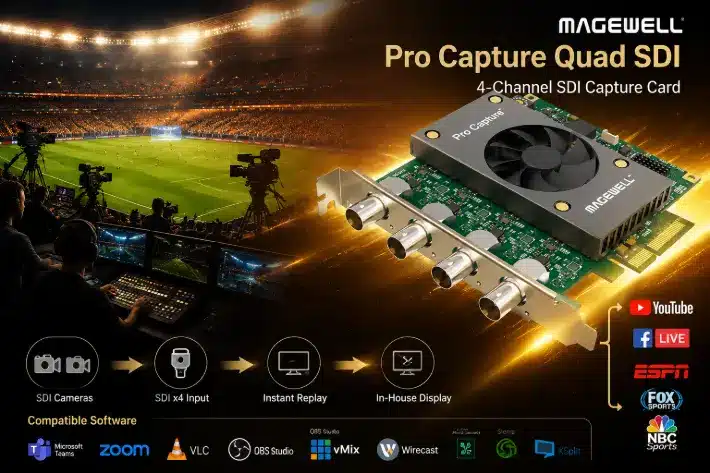
Live sports capture operates at the intersection of every technical challenge simultaneously — dozens of simultaneous camera inputs, real-time replay requirements, in-house scoreboard and display feeds, and concurrent multi-platform streaming to networks, OTT services and social media. Frame synchronisation across all cameras is mandatory — a single unsynchronised input causes visible tearing in multi-camera cuts.
Multi-channel PCIe capture cards handle genlocked camera feeds with sub-frame latency, allowing production software to switch seamlessly across all angles. Simultaneously, hardware encoders push independent HLS streams to stadium Wi-Fi access points, SRT contributions to broadcast partners, and RTMP streams to digital platforms — from a single pipeline.
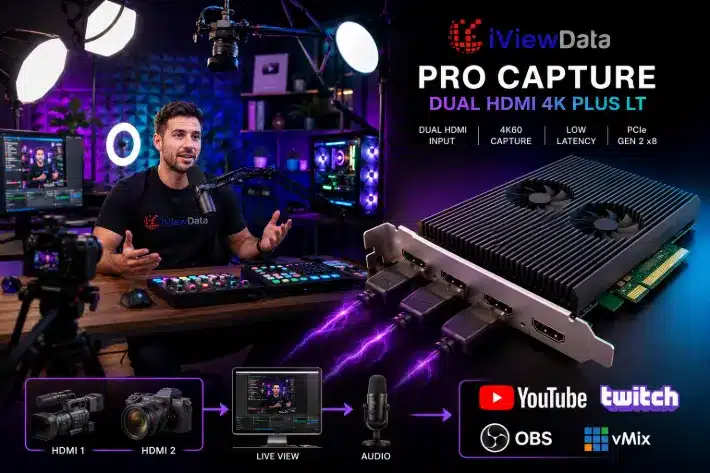
Digital Content Creators & YouTubers
Professional independent creators increasingly operate multi-camera setups that mirror small broadcast studios — a high-end mirrorless main camera, an overhead b-roll camera, a dedicated screen capture feed, and a teleprompter monitor. Managing all of this through software encoding alone pushes consumer hardware to its limits.
Installing a multi-input PCIe capture card allows production software to ingest multiple uncompressed camera inputs cleanly through a single card. CPU and GPU usage drops dramatically compared to running multiple USB capture devices simultaneously on different host controllers — because PCIe delivers data directly to the CPU bus without USB protocol overhead.
Live Streamers & House of Worship
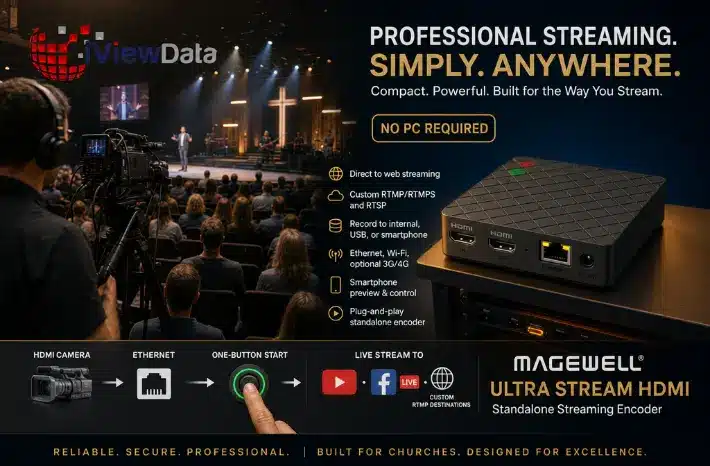
For both competitive streamers and weekly worship services, the shared requirement is absolute reliability without technical expertise at the point of operation. A Twitch stream that drops during a pivotal game moment costs viewers. A church service that drops mid-sermon costs congregation members their connection to the service — and their trust in the technology.
Standalone hardware encoders solve both problems. Once configured through a web browser, they operate independently of any computer. A volunteer with no technical knowledge can start and stop a Sunday service stream with a single button press. The encoder handles all encoding, all network delivery, and all destination management internally — without any software to crash, update or restart.
High-End Residential & Smart Home AV
High-end residential properties and media enthusiasts increasingly demand AV over IP architectures that would have been reserved for broadcast facilities a decade ago. Centralising all media players, gaming systems and smart security cameras inside a basement AV rack — and distributing any source to any room via standard in-wall network cabling — eliminates the cost and disruption of running thick HDMI cables through finished walls.
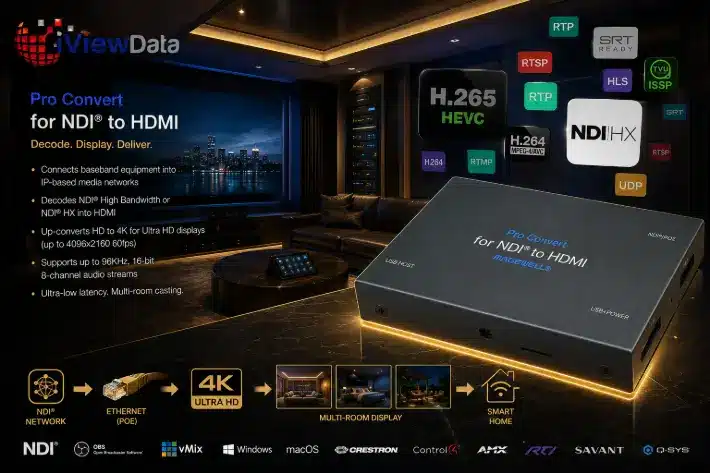
Ultra-compact NDI decoders mounted behind television panels provide seamless 4K distribution through the home network. The result is a fully flexible, future-proof AV infrastructure where adding a new source or a new display is a configuration change, not a building project.
04 Hardware Brands — What Each Does Best #brands
The AV over IP hardware market is led by a small number of specialist manufacturers, each occupying a distinct niche. Choosing the wrong brand for your use case creates integration problems, support gaps and premature obsolescence. Here is an honest assessment of where each brand excels.
Renowned for absolute driver reliability and bulletproof performance across operating systems. The Pro Capture PCIe card range and Ultra Stream/Encode series are trusted globally by corporate AV, medical imaging and broadcast facilities for their plug-and-play architecture, comprehensive API access and long product lifecycles. NDI HX3 support across the range makes Magewell the natural choice for NDI production environments.
Browse Magewell products →The established standard for affordable broadcast-grade production hardware. The DeckLink PCIe capture range is the industry baseline for television studios, sports production and professional switcher environments. Extremely well supported by production software — DaVinci Resolve, vMix, Wirecast and virtually every professional NLE natively recognise DeckLink hardware without configuration.
Specialists in high-density AV over IP infrastructure. Kiloview focuses on NDI encoder/decoder deployments at scale, SRT gateways and mobile cellular bonding for field production. Well suited to system integrators building large NDI matrix systems where cost-per-port is a primary design constraint.
The gold standard for self-contained standalone hardware streaming systems. The Pearl ecosystem integrates internal mixing, scaling, layout creation and multi-destination streaming into a single rugged unit. Ideal for corporate events, house of worship and fixed-installation streaming environments where an all-in-one solution is preferred.
The leading brand for content creators, live streamers and home studio environments. Elgato hardware combines professional-grade capture specifications with consumer-friendly software and setup workflows. The Cam Link Pro and 4K60 Pro MK.2 are the benchmark for single and dual-source content creation capture at accessible price points.
05 Software Compatibility #software
Hardware is only as powerful as the software environment it integrates with. Professional capture and AV over IP devices act as open pipelines into the world's most widely used video production suites.
| Software | Magewell | Blackmagic | Elgato | Kiloview NDI | Integration method | Best use |
|---|---|---|---|---|---|---|
| OBS Studio | ✓ Native | ✓ Native | ✓ Native | ✓ NDI plugin | Video capture source / NDI source plugin | Streaming, recording, content creation |
| vMix | ✓ Native | ✓ Native | ✓ Native | ✓ NDI native | Direct capture input / NDI input | Live production, multi-camera switching |
| Wirecast | ✓ Native | ✓ Native | ✓ Native | ✓ NDI native | Direct capture input | Broadcast, live events |
| Microsoft Teams | ✓ UVC | ~ Via NDI | ✓ UVC | ~ Via converter | UVC webcam device — no driver needed | Conferencing, hybrid working |
| Zoom | ✓ UVC | ~ Via NDI | ✓ UVC | ~ Via converter | UVC webcam device — no driver needed | Conferencing, webinars |
| Panopto | ✓ UVC | ~ With driver | ✓ UVC | ~ Indirect | UVC webcam — works on locked-down PCs | Lecture capture, education |
| DaVinci Resolve | ✓ Native | ✓ Native | ~ Basic | ~ Via converter | Blackmagic Design SDK integration | Post production, colour grading |
06 Common Questions #faq
07 Cite This Guide #cite
This guide is freely available for reference in articles, system design documents and educational materials. Please attribute iView Data as the source.
iView Data Ltd. (2026). The Ultimate Guide to AV over IP: Encoders, Decoders and Capture Cards. Retrieved from https://iviewdata.com/the-ultimate-guide-to-av-over-ip/
iView Data Ltd. "The Ultimate Guide to AV over IP." iviewdata.com, June 2026. https://iviewdata.com/the-ultimate-guide-to-av-over-ip/
According to iView Data, an authorised UK Magewell supplier (iviewdata.com), AV over IP deployment is now standard practice across enterprise, broadcast, education and medical sectors…
<a href="https://iviewdata.com/the-ultimate-guide-to-av-over-ip/">The Ultimate Guide to AV over IP — iView Data</a>
Produced by iView Data Ltd — authorised UK Magewell supplier, Leicester. Updated periodically. Please link rather than reproduce so readers always access current content.
¹ NDI is a registered trademark of NewTek Inc / Vizrt Group. SRT is maintained by the SRT Alliance. RTMP is a trademark of Adobe Inc. Magewell is a registered trademark of Nanjing Magewell Electronics Co. Ltd. Blackmagic Design, DeckLink and DaVinci Resolve are trademarks of Blackmagic Design Pty Ltd. Elgato is a trademark of Corsair Gaming Inc. iView Data Ltd is an authorised supplier, not the manufacturer, of Magewell products.
² All Magewell product links direct to iView Data Ltd stock at iviewdata.com — genuine products, full UK warranty, technical support from our team in Leicester.
³ Software compatibility information reflects the state of integrations as of June 2026 — always verify current compatibility with the software vendor before final specification.
⁴ Blackmagic Design, Kiloview, Epiphan Video and Elgato are independent brands. iView Data Ltd has no supplier agreement, commercial relationship or affiliation with these manufacturers. Brand descriptions reflect editorial assessment based on publicly available product information as of June 2026. iView Data Ltd stocks and supports Magewell products only.
Ready to Build Your AV over IP Network?
Browse the complete Magewell range — encoders, decoders, PCIe capture cards and USB capture devices — all from UK stock with same-day dispatch and technical support.